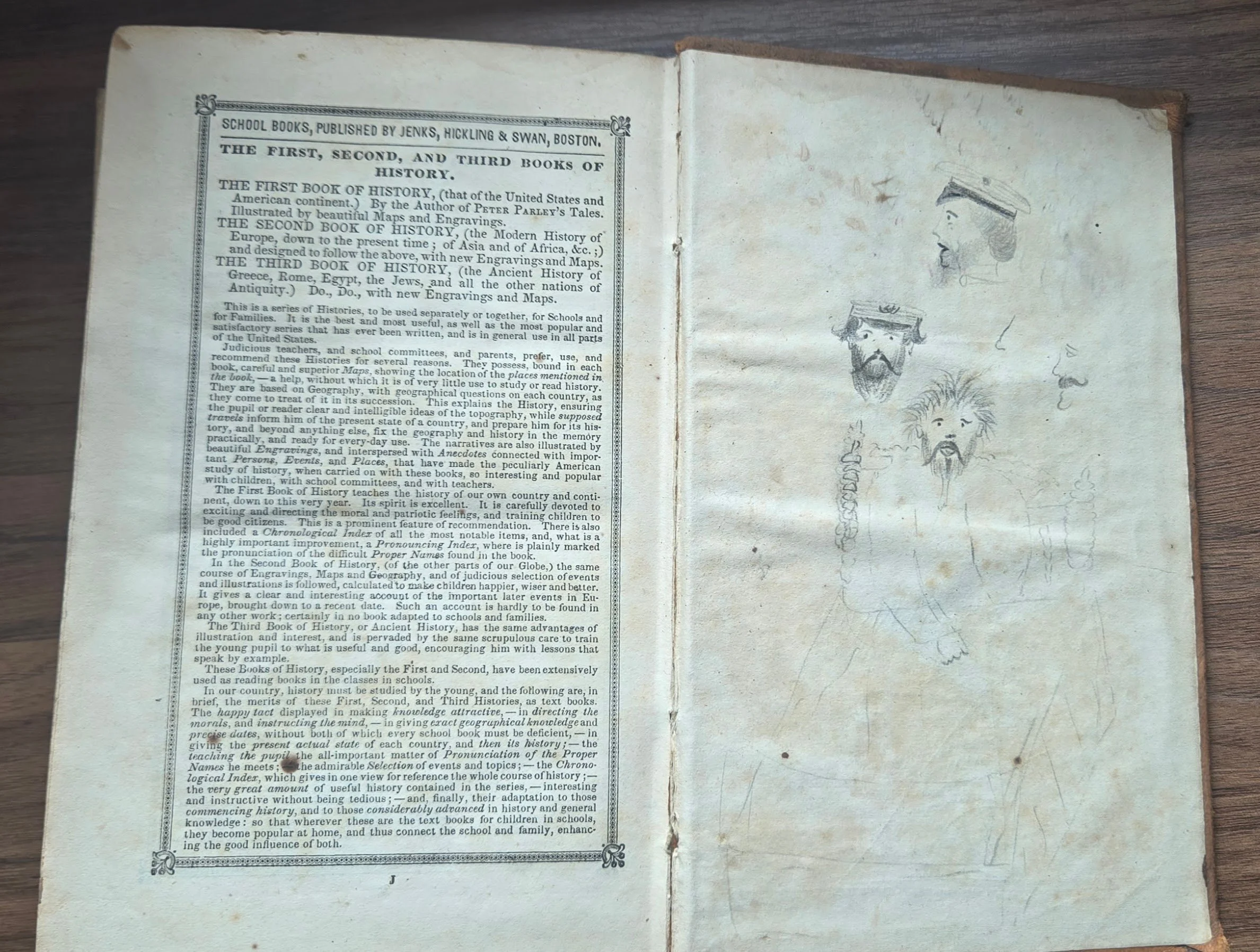
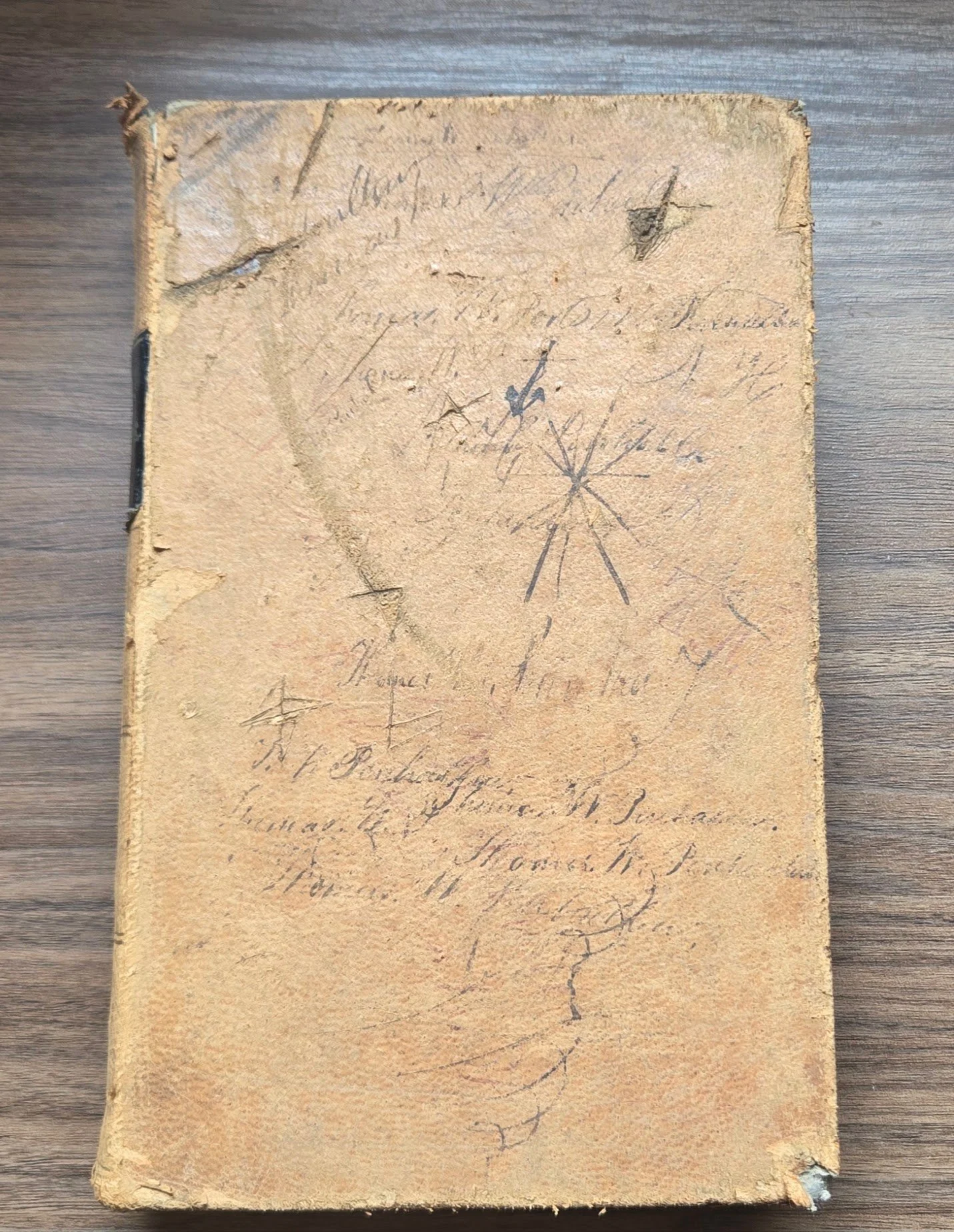
As most of the area’s students have now gone back to school, let’s examine a delightful piece in the Warner House’s book collection: The Comprehensive Pronouncing and Explanatory Dictionary of the English Language by Joseph E Worcester. This particular version was published in Boston in 1855, and was owned and used by Thomas Wibird Penhallow (1846-1930) who also became the last family member to live in the house before it became a museum. Thomas was 9 years old when this “revised, with important additions” was available, and while we don’t know exactly when he received it, it’s likely he had it soon after its publication.
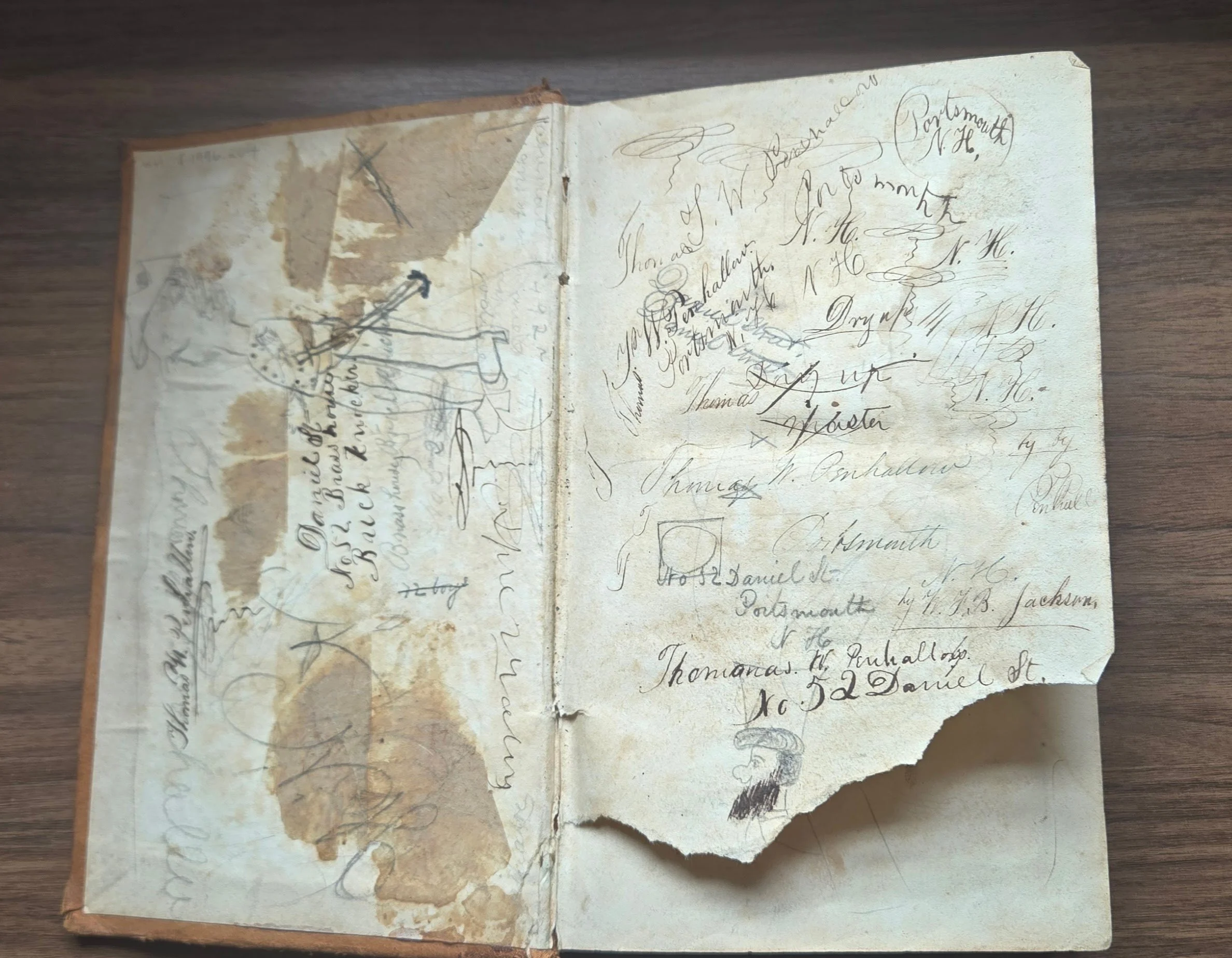
Thomas doodled quite a bit in the beginning of the book and its covers – both inside and out. There aren’t many marks throughout the pages – did he actually use the book beyond doodle paper? We don’t know much about his schooling and the type of student he was, but we do know he enlisted as a midshipman in the Navy in 1861 and served four years. Afterwards, he moved to Boston and spent his career in insurance. He never married nor had any children. In the 1880 Census, he’s listed as living at home with his parents and brother, at 7 St. James Ave., and working in fire insurance. In 1912, he’s listed in city directories at the same address, presumably inheriting the house from his parents. The family called him “Uncle Tom,” and he spent summers in Portsmouth at the Warner House, along with his Aunt Evvy. After he died in 1930, the house was left to the children of his brother, Charles Sherburne Penhallow, who did not want the house and had plans to sell the property to Standard Oil, who was going to turn it into a gas station.
Many of his doodles are of him practicing his penmanship, notably his name and address. But as many young boys are wont to do, he drew several soldiers with large hats and copious facial hair. It’s a delightful peak into the playfulness of Thomas as a boy – details and notions that often get forgotten as they’re not necessarily recorded. It’s these tangible objects that help us better understand those from the past as more complete people – especially when the details of one’s life are lacking.
The author of this dictionary is Joseph Emerson Worcester, who had some famous friends but was in a decades-long feud with none other than Noah Webster. Who knew dictionary authors could be so competitive?
Worcester and Webster both published various versions of their works relatively close in time in the late 1820s. In turn, charges of plagiarism were slung, first from Worcester towards Webster, and then Webster towards Worcester. Both men insisted they had started their work first. While Worcester focused on more traditional spelling and pronunciation, Webster focused his attention on Americanizing the English language. The “Dictionary Wars,” escalated when more serious attacks began. In 1834, Webster outright accused Worcester of plagiarizing definitions of more than 100 words. The two men went back and forth for years, and the feud even continued after Webster’s death in 1843 when the Merriam Company owned the rights to Webster’s American Dictionary.
Worcester continued to revise and publish his dictionary despite more competition from other authors and companies, until his death in 1865. His last update, posthumously published in 1886, was easily overshadowed by another Merriam-Webster edition, Webster’s International, among others.
Worcester was born in Bedford, NH, and worked on a farm before attending Phillips Andover and Yale, later starting a school in Salem in 1812. One of his students was none other than Nathaniel Hawthorne! Worcester wrote several textbooks on geography and history before changing his focus to the English language in the 1820s. In the 1840s, he married and lived in Cambridge, MA. He and his wife, Amy McKean, rented rooms in Craigie House, and lived there at the same time as Henry Wadsworth Longfellow. The two men became friends and socialized with Nathaniel Hawthorne. The Craigie House was the headquarters of George Washington during the Siege of Boston and is now known as the Longfellow House – Washington’s Headquarters National Historic Site.