
What is a Patten?
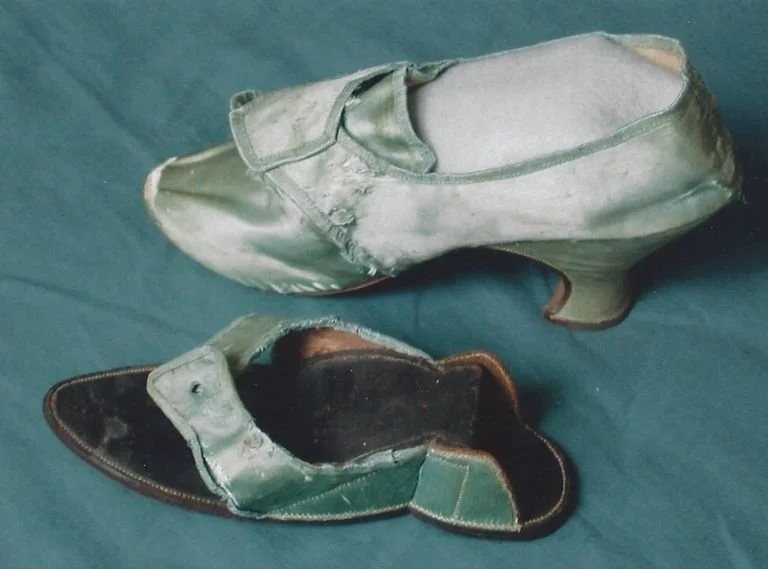
18th century single heeled shoe with light blue/green silk paired with a patten, which inserts around the heel to create a flat surface onto which one could walk.
Have you ever wondered how someone might protect their feet while walking through snow in the past? Footwear certainly has evolved over the centuries and luckily in the 21st century, we have a mind-boggling amount of options to keep our feet warm and dry throughout the winter. But for someone like Mary Macpheadris Warner, who was not only born in the Warner House, but also lived there with her second husband, Jonathan Warner in the 1760s, she had far fewer options - despite her wealth. Women of means were able to afford, and wear, fashionable shoes. Delicately made, often with silk and thin leather, they were as impractical as they were uncomfortable - especially in the winter! There are little to no surviving evidence that women wore any sort of winter boots until the 19th century. Here’s where the shoe patten comes in, one of which is pictured in the bottom of the picture - a mid-18th century example. It served to protect women’s shoes in all seasons while walking on rough roads and sidewalks and especially in mud and snow. The shoe would slip into the patten and was secured by the straps over the mid-part of the foot. Some were tied with ribbons and in this example, it looks like a buckle may have been used. The patten not only protected the shoe, but also gave an even, level surface on which to walk. Paired with woolen petticoats and socks, and perhaps spatterdashers, one may have been able to to keep their legs and feet warm for a time. It’s doubtful the wearer of this shoe and patten used them in the snow, given how fine of an example they are, but it helps to give us an idea of how women in the past solved practical problems we still deal with today.Unfortunately neither of the matching shoe and patten survive, and to be clear, were not owned by Mary Warner. They were given to the Warner House Association in 1938 by Mrs. W.G. Wendell (Evelyn) who was a daughter-in-law of Edith Wendell, who helped to save the Warner House from demolition in 1931.For more info and reference, visit: https://collections.vam.ac.uk/item/O115851/shoe-and-patten-unknown/ or http://www.silkdamask.org/